What If You Could Feel Tel Aviv’s Soul in Just One Slow Week?
Imagine walking through a city where ancient stones whisper stories, and every alley hums with music, art, and fresh pita warmth. That’s Tel Aviv—not just a destination, but a living rhythm. I spent a quiet week diving into its cultural heartbeat, skipping the rush, savoring moments. From morning markets to midnight murals, I discovered how slowing down unlocks the real magic. This isn’t tourism—it’s connection. In a world that glorifies speed, choosing to move slowly through a place like Tel Aviv becomes an act of reverence. It allows the city to reveal itself not in snapshots, but in sustained, breathing moments that linger long after you’ve left.
The Pulse Beneath the Sand: Understanding Tel Aviv’s Cultural Identity
Tel Aviv is more than a coastal gem on the eastern Mediterranean; it is a living testament to resilience, reinvention, and cultural fusion. Founded in 1909 as a small garden suburb of the ancient port city of Jaffa, it has grown into Israel’s dynamic cultural and economic heart. Yet, beneath its modern skyline and buzzing nightlife lies a layered identity shaped by waves of immigration, artistic ambition, and a deep-rooted connection to both land and sea. The city’s soul is not preserved behind glass cases—it pulses in everyday life, from the hum of Hebrew and Arabic in the marketplace to the aroma of cardamom coffee drifting from open windows.
What makes Tel Aviv unique is its ability to balance contrasts. It is a city that honors tradition while embracing innovation, where ancient Middle Eastern flavors blend seamlessly with European urbanism. The architectural heritage of the White City, a UNESCO World Heritage site, showcases over 4,000 Bauhaus-style buildings constructed in the 1930s by Jewish architects fleeing Europe. These clean, functional lines reflect both aesthetic modernism and a yearning for order amid upheaval. At the same time, the city’s streets are alive with improvisation—graffiti-covered walls, pop-up galleries, and impromptu dance circles on the beach.
Culture here is participatory, not performative. It’s not something you observe from a distance; it invites you in. A grandmother selling pickled lemons at the Carmel Market will share her family’s recipe if you ask. A street musician in Florentin might pause to teach you a few chords. This openness stems from a society built by immigrants, where storytelling and sharing are acts of belonging. To understand Tel Aviv is to recognize that its identity is not fixed—it is constantly being remade through conversation, cuisine, and creativity.
Why Slow Travel Fits Tel Aviv Like a Second Skin
Slow travel is not merely a trend; it is a philosophy that aligns perfectly with the rhythm of Tel Aviv. Unlike destinations designed for checklist tourism, this city rewards patience, curiosity, and presence. The idea of slow travel—immersing oneself in a place over time, engaging with local life, and prioritizing depth over distance—finds a natural home here. In a typical week, most tourists rush from the beach to Ben-Gurion Airport, squeezing in a hurried falafel and a quick stroll through Rothschild Boulevard. But those who stay longer, who allow themselves to wander without agenda, discover a different Tel Aviv—one that reveals itself in quiet moments.
Slowing down transforms the experience from observation to participation. Instead of photographing a mural, you might meet the artist painting it. Rather than buying a souvenir, you could learn how it was made. One morning, I sat at a corner café in Neve Tzedek for over an hour, watching the neighborhood wake up. A local woman walking her dog paused to comment on the weather. A shopkeeper opened shutters with a familiar tune whistling from his lips. These small interactions, invisible to the hurried visitor, became the most memorable parts of my trip.
Moreover, slow travel reduces the fatigue often associated with tourism. Without the pressure to see everything, there is space to truly absorb what you do see. I found myself returning to the same park bench near the Yarkon River, noticing how light changed across the water at different times of day. I revisited a small bakery, not for the pastries alone, but to exchange smiles with the baker who began to recognize me. These repetitions, often avoided in conventional travel, foster a sense of belonging. In Tel Aviv, where life unfolds at a human pace, moving slowly is not a luxury—it is the most authentic way to travel.
Morning Light in Neve Tzedek: A District That Breathes Art
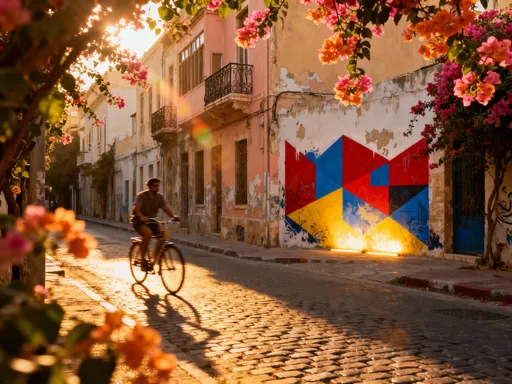
Neve Tzedek, one of Tel Aviv’s oldest neighborhoods, feels like a secret whispered between friends. Nestled just south of the bustling city center, it escaped major redevelopment and retains a village-like charm. Its narrow streets, lined with pastel-colored homes and flowering bougainvillea, were once home to early Jewish settlers. Today, they house boutique galleries, design studios, and intimate cafés where time seems to pause with the first sip of coffee. Walking through Neve Tzedek in the early morning is like stepping into a watercolor painting—soft light filters through latticework balconies, casting delicate shadows on stone pathways.
The district’s artistic soul is palpable. Every doorway seems to tell a story, painted in bold hues of turquoise, terracotta, or sage green. Murals blend seamlessly with the architecture, some whimsical, others deeply symbolic. One wall depicts a woman with eyes closed, listening to a seashell—perhaps a metaphor for the neighborhood itself, attuned to quieter frequencies. Galleries like the Suzanne Dellal Centre for Dance and Theatre host rotating exhibitions and performances, but even the streets function as open-air museums. A simple stroll can lead to unexpected encounters: a violinist practicing in a courtyard, a ceramicist arranging handmade tiles in a sunlit studio window.
To wander mindfully through Neve Tzedek is to engage all the senses. Stop at a sidewalk café and order a flat white with a slice of date cake. Listen to the clink of cutlery, the murmur of conversations in Hebrew and English, the distant call to prayer from a nearby mosque. Touch the cool stone walls, weathered by decades of sea air. Smell the jasmine blooming in hidden gardens. These details are not distractions—they are the essence of the place. For visitors, the key is to resist the urge to document everything. Instead, put the phone away and simply be. Let the neighborhood unfold at its own pace. If you’re lucky, a gallery owner might invite you in for a private viewing, or a resident might share a story about how their family has lived here for generations.
Cultural Feasts: How Food Tells the Story of a City
In Tel Aviv, food is not just sustenance—it is history, identity, and hospitality served on a plate. The city’s culinary landscape is a direct reflection of its multicultural roots, shaped by Jewish communities from across the Middle East, North Africa, Europe, and beyond. Breakfast might begin with shakshuka—slow-cooked tomatoes, peppers, and eggs seasoned with cumin and paprika—served at a family-run café where the owner greets regulars by name. This dish, originally from North Africa, has become a national favorite, symbolizing the blending of traditions.
By midday, the scent of grilled eggplant and fried eggplant draws you to a sabich stand tucked between two laundromats in Florentin. Sabich, a sandwich of Iraqi origin, layers fried eggplant, hard-boiled eggs, amba (a tangy mango pickle), and tahini in fluffy pita. It’s messy, flavorful, and deeply satisfying—a street food born of home kitchens and humble beginnings. Eating it at a plastic table on the sidewalk isn’t just convenient; it’s part of the experience. There’s no pretense, only authenticity.
Dinner might lead to a Yemenite bakery in the Levinsky Market, where women in headscarves shape dough by hand and slide it into wood-fired ovens. Here, you’ll find jachnun, a rolled pastry baked overnight and served with grated tomato and zhug, a spicy green condiment. The flavors are bold, unapologetic, and deeply rooted in tradition. Dessert could be a knafeh from a Palestinian-owned shop in Jaffa—shredded phyllo soaked in syrup, layered with cheese, and dusted with crushed pistachios. Each bite carries generations of craftsmanship.
To eat in Tel Aviv like a local is to embrace variety, spontaneity, and connection. It means skipping fancy restaurants for hole-in-the-wall gems, asking for recommendations, and learning a few words of Hebrew or Arabic to order. It means understanding that a meal is not just about taste, but about the story behind it. When you share food with others—whether at a communal table or a quiet corner booth—you are not just consuming; you are participating in the city’s ongoing narrative.
When the City Dances: Experiencing Music and Street Performance
Musicality is woven into the fabric of Tel Aviv. It spills from open windows, echoes along the promenade, and rises from the sand dunes near the port. The city has long been a haven for artists, and its soundscape reflects that diversity. On any given evening, you might stumble upon a jazz trio playing under the palms at Charles Clore Park, their melodies blending with the crash of waves. Or you might hear the deep resonance of a darbuka drum calling people to gather on the beach, forming a spontaneous circle of rhythm and dance.
These moments are not staged for tourists; they are organic expressions of urban life. In Tel Aviv, music is a communal act, not a commodity. Young musicians test new compositions in public squares. Elders gather in parks to sing nostalgic songs from their countries of origin. At the Tel Aviv Port, converted warehouses host indie gigs featuring everything from electronic remixes of traditional piyyutim (Jewish liturgical poems) to soulful rock ballads in Hebrew. The atmosphere is inclusive, never exclusive.
Attending these performances fosters a rare kind of cultural insight. You’re not watching from a balcony or a reserved seat—you’re part of the audience standing barefoot in the sand, swaying to a beat you don’t yet know. One night, I joined a drum circle near Alma Beach. No one spoke much, but the rhythm created a shared language. A German tourist, an Israeli student, and an elderly Yemenite man all played together, smiling as the tempo rose. In that moment, differences dissolved. Music became the bridge.
For the slow traveler, these experiences are priceless. They cannot be scheduled or predicted. They emerge from being present, from choosing to linger when others move on. By opening yourself to the city’s sonic landscape, you tune into its emotional frequency. You begin to feel, not just hear, the pulse of Tel Aviv.
Museums Without Walls: Tel Aviv’s Open-Air Culture Scene
Tel Aviv offers world-class museums, from the Tel Aviv Museum of Art to the Independence Hall where Israel’s statehood was declared. Yet some of the most profound cultural experiences happen far from curated galleries. The city itself is an open-air museum, where architecture, street art, and public installations tell stories without labels or admission fees. A walk through the White City is a lesson in modernist design, with its grid of Bauhaus buildings featuring rounded balconies, pilotis (supporting columns), and whitewashed facades designed to reflect the harsh Mediterranean sun.
Guided architectural tours provide historical context, explaining how European-trained architects adapted their styles to the local climate and social needs. But even a self-guided stroll can be enlightening. Notice how sunlight plays across textured walls, how courtyards offer shade and privacy, how small details—like wrought-iron railings or ceramic tiles—hint at personal touches. These buildings are not relics; they are lived-in, loved, and continuously restored by residents who value their heritage.
Equally compelling are the city’s graffiti lanes, particularly in the southern neighborhoods of Florentin and Shapira. What began as acts of rebellion have evolved into a recognized art form. Murals cover entire building facades, depicting everything from political commentary to poetic abstractions. Some honor local heroes; others celebrate universal themes of peace, memory, and resilience. Unlike in cities where street art is quickly erased, Tel Aviv often embraces it, commissioning artists to transform dull walls into vibrant canvases.
Exploring these open-air spaces requires no ticket, no timetable. You can spend ten minutes or three hours. You can go alone or strike up a conversation with a fellow observer. The joy lies in discovery—the unexpected fresco around a corner, the hidden courtyard filled with sculptures, the child’s chalk drawing beside a professional mural. In these moments, culture is not something you consume; it is something you co-create by paying attention.
The Human Rhythm: Connecting Through Language, Laughter, and Local Life
Beyond monuments and menus, the true heart of Tel Aviv beats in its people. Over the course of a week, I found that the most transformative moments came not from planned activities, but from unplanned conversations. Sitting on a park bench in Yarkon Park, I shared a bag of sunflower seeds with an elderly man who had lived through the city’s early decades. He spoke slowly, his Hebrew accented with traces of Russian, and pointed to a fig tree. “That was here when I was a boy,” he said. “It remembers more than I do.”
At a spice stall in the Carmel Market, the vendor noticed my hesitation and offered a taste of za’atar on a piece of warm pita. “This,” he said with a smile, “is how we say welcome.” His hands, stained with turmeric and sumac, moved with practiced ease. We didn’t share a language, but we shared a moment. These small exchanges—brief, unscripted, genuine—are the currency of deep travel.
Patience and presence open doors that no tour guide can unlock. When you linger at a coffee shop, return to the same fruit stand, or simply nod hello to the same neighbors each morning, you begin to be seen. You transition from observer to participant. A shopkeeper might invite you to taste a new batch of halva. A dancer from the Suzanne Dellal Centre might offer a few beginner moves. These gestures are not performances; they are offerings of trust and inclusion.
In a world that often feels disconnected, Tel Aviv reminds us that community is built in moments of mutual recognition. Slowing down creates space for these moments to occur. It allows you to listen, not just hear. To see, not just look. And in that space, travel becomes less about where you’ve been and more about who you’ve met along the way.
Closing the Loop: Why Culture Is the True Souvenir
By the end of my week in Tel Aviv, I realized I hadn’t collected many physical souvenirs. No keychains, no mugs, no trinkets from gift shops. What I carried with me were memories—of shared laughter, unexpected kindness, and the quiet beauty of a city that reveals itself only to those who take the time to listen. Each experience, from the first bite of shakshuka to the final drumbeat on the beach, was a thread in a larger tapestry of connection.
Tel Aviv taught me that culture cannot be rushed. It unfolds in layers, like the peeling paint on a century-old door or the slow fermentation of sourdough in a neighborhood bakery. It asks for attention, not just arrival. When we slow down, we stop treating cities as backdrops for our photos and start seeing them as living entities with stories to share.
This journey was not about checking off landmarks. It was about tuning into a frequency—of music, of flavor, of human warmth—that exists beneath the surface. It was about discovering that the deepest form of exploration is not movement, but stillness. Not speed, but slowness. In choosing to move gently through Tel Aviv, I didn’t just visit a place. I connected with its soul. And that, more than any photograph or souvenir, is what I brought home.